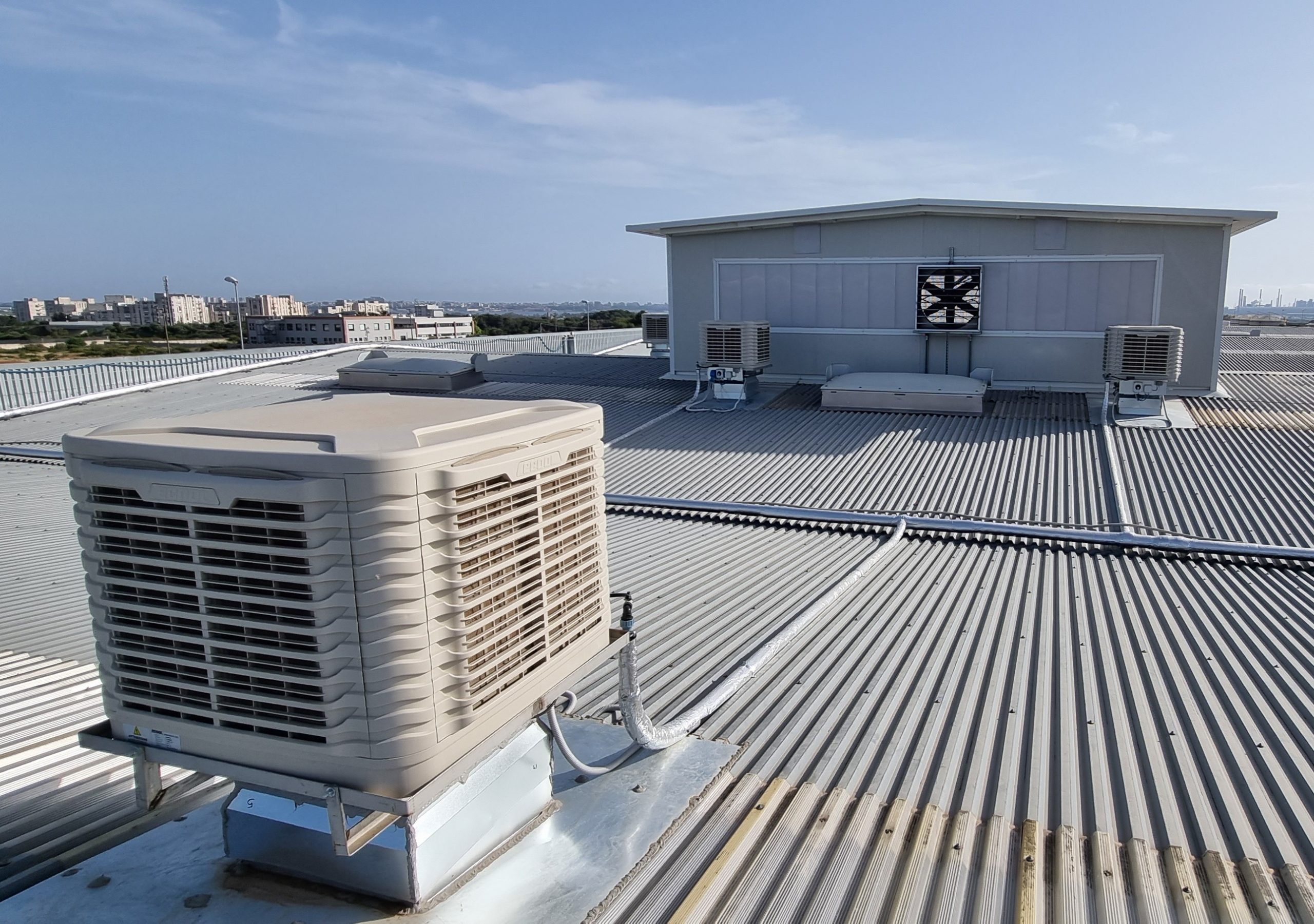
In industrial environments, logistics warehouses, mechanical workshops and production departments, heat is not just an inconvenience — it is a factor that directly affects efficiency, work quality and safety.
In these contexts, traditional air conditioning is often not the ideal solution because of:
- large volumes that need cooling
- loading bays and doors that remain open
- high ceilings
- significant energy costs
Evaporative cooling offered by Art-Eco represents a technology specifically designed for these types of environments.
How It Works
The system uses a natural principle: water evaporation absorbs heat from the air.
Hot external air passes through special wet panels. During this process, the water evaporates and removes heat from the air, introducing cooler air into the environment that is constantly renewed and oxygenated.
Unlike recirculating systems, evaporative cooling does not reuse indoor air. Instead, fresh air is continuously introduced, improving overall air quality in the workplace.
Real Benefits: Practical Application Examples
1. Logistics Warehouse with Open Loading Bays
Problem:
During summer, temperatures can exceed 34–36°C. Operators handling goods work constantly in motion, requiring significant physical effort.
Effects of heat:
- increased fatigue
- more frequent breaks
- slower order preparation
- higher picking error rates
With Art-Eco evaporative cooling:
- perceived temperature reduction of up to 6–8°C
- continuous flow of fresh air even with doors open
- improved tolerance to physical effort
- consistent operational rhythm throughout the day
Result:
Less productivity loss during peak heat hours and more stable performance.
2. Mechanical Workshop or Production Department
Problem:
Machines and manufacturing processes generate additional heat, making the air heavy and stagnant.
Effects of heat:
- reduced attention during precision work
- increased micro-errors
- higher risk of accidents
With evaporative cooling:
- constant air movement
- improved heat dissipation
- reduction of perceived thermal stress
Result:
Better concentration during technical tasks and reduced risk related to distraction.
3. Facilities with High Ceilings
Problem:
Hot air tends to accumulate at the top of large industrial buildings, creating thermal stratification.
With traditional systems:
- cooling such large volumes is expensive
- efficiency decreases with frequent door openings
With Art-Eco evaporative cooling:
- uniform air distribution
- effective cooling even in very large spaces
- significantly lower energy consumption compared to compressor-based air conditioning systems
Result:
A balance between comfort and economic sustainability.
Direct Impact on Productivity
When perceived temperature decreases and air becomes easier to breathe:
- the feeling of fatigue decreases
- mental clarity improves
- workers maintain attention for longer periods
- the need for recovery breaks is reduced
Evaporative cooling is not only a technical choice — it is a strategic one.
It means:
- improving the overall workplace environment
- protecting human capital
- maintaining production continuity
- reducing indirect costs caused by errors, slowdowns and minor accidents
Energy Efficiency and Sustainability
One of the distinctive advantages of Art-Eco systems is their low energy consumption compared to traditional air conditioning systems.
Lower energy consumption means:
- lower operating costs
- reduced environmental impact
- faster return on investment
In a context where companies increasingly focus on energy costs and sustainability, evaporative cooling becomes a solution aligned with ESG objectives.
In Summary
Heat in the workplace is not inevitable.
It can be managed intelligently.
Art-Eco evaporative cooling offers a concrete solution to:
- improve comfort
- support productivity
- reduce heat stress
- optimize energy costs
- create a healthier working environment
Investing in cooling means investing in people.
And in any company, people make the difference.
Are you interested in more information
on evaporative cooling
Scopri i nostri prodotti